The new regulations for 2026 have necessitated many innovations in Formula One. As innovation is the name of the game, this should be an opportunity for the teams to flex their intellectual muscles and come up with exciting new concepts for their cars. Ferrari has not let us down.
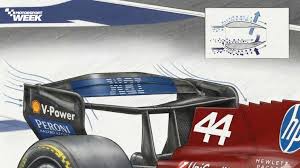
Ferrari's revolutionary Macarena rear wing.
Formula One has always stipulated that aerodynamic aids must be passive, by which they mean that they cannot move mechanically. The new regulations have introduced active aerodynamic aids for the first time (other than the DRS). This is a great leveller for the teams, as it is completely new. There is not a store of knowledge available within Formula One on active aerodynamics. For the rear wing, Ferrari have stood out with their innovative solutions.
Dubbed the Macarena wing, Ferrari have a rear wing that does not just open and shut, but actually rotates. When it was first deployed by Lewis in Pre-Season Testing, Ollie Bearman, who was behind him on the track, was convinced the wing had broken at first. The paddock was stunned.
https://youtu.be/U_eM9jBHdxI?si=jPz6H9T8InkMC0aX
Other teams claimed they had considered making such a wing but had decided that there were too many downsides. Others admitted that they hadn’t considered it. Only Ferrari had brought one to the track to try out. They did not use it in Australia and only trialled it in Practice in China. It is reported that the Macarena wing will also be used in Japan.
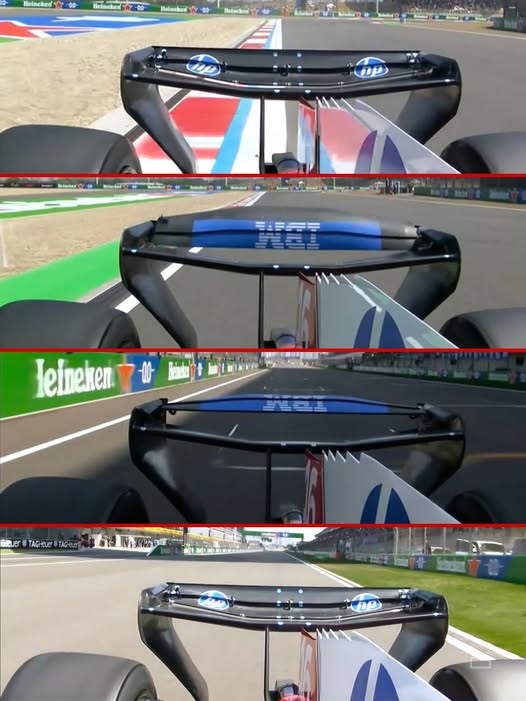
So what are the benefits of the wing and what problems might it bring?
The regulations specify that the active aero component has two modes: X-Mode (low drag) on the straights and Z-Mode (high downforce) in corners. The X-Mode can be activated on any straight regardless of the proximity of the car in front (1 second rule). This brings dynamic adjustment, giving more grip in the corners and the boost in speed on the straights. Another consequence of this innovation is longer braking zones, which provides more opportunities for overtaking, as we have seen in the first two races this season.
The wing can rotate because Ferrari have removed the central actuator and replaced it with two actuators one on either side. When it deploys, the initial drag peak is higher than the conventional wing, but then the drag reduction that follows is much lower, giving them a significant boost of speed on the straight. According to Bernie Collins of Sky F1, an extra 5KM per hour.
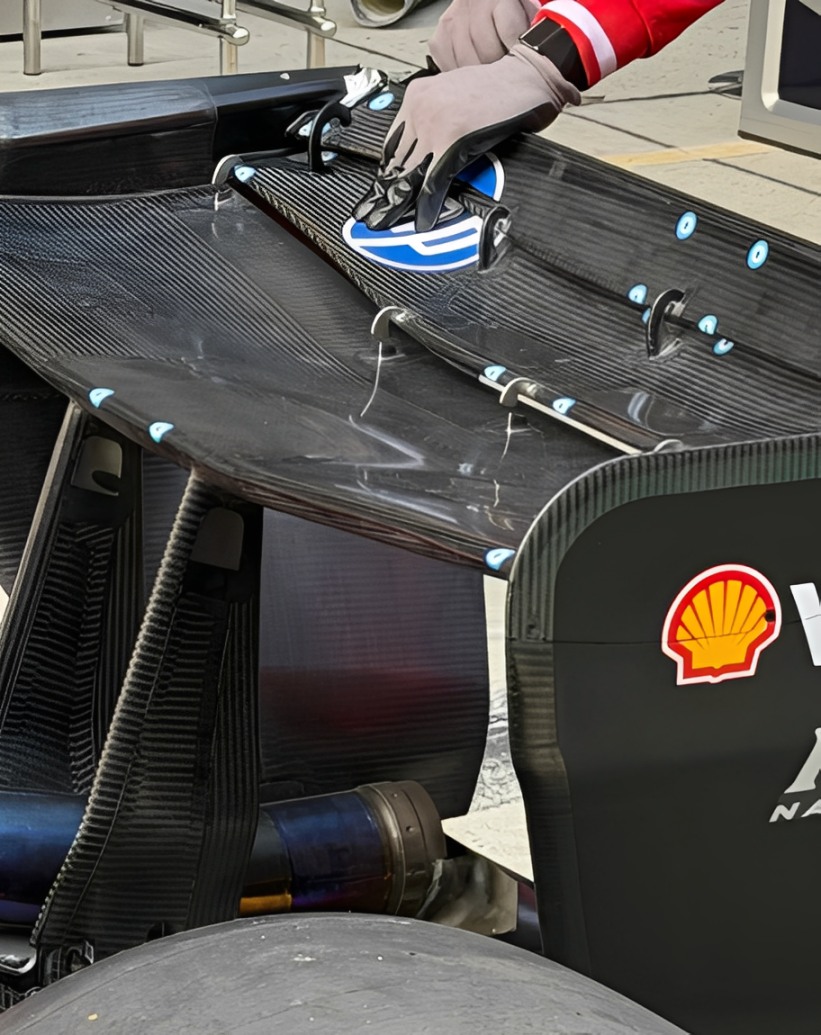
Fitting an innovation onto a race car is an art in itself. The car is one big set of interconnecting systems and any variant can have unforeseen consequences. Ferrari have not given the wing a lot of public mileage. It is possible that the structural integrity may not be as reliable as the conventional wing. By inverting the wing, it not only reduces drag, but could even generate lift; this could have an effect on tyre wear over a race distance.
We wait to see if the Macarena wing is brought out for a practice session in Japan and whether Ferrari try it in the race.
Photo by Imago-Ipa Sport.
There has been much discussion about the new regulations and if they are in the spirit of Formula 1. When it comes to the active aero, I think this is entirely within the pioneering spirit of F1. The Formula 1 community have learned pretty much all there is to know about passive aerodynamic aids. By introducing the active aero specification, the sport’s aerodynamicists are given an entirely new challenge. Ferrari has risen to the challenge and the Macarena wing is the epitome of F1 innovation. I hope we get to see it race.
By Clare Topic
Videos



Comments
Authorize to comment